

Clutch does not disengage.
Causes
If the clutch does not disengage, the problem is not necessarily the clutch itself. Frequent causes include faults in the release system, a jammed pilot bearing, or non-compliance with important installation requirements.
Therefore, check:
- Were all professional check points observed during installation?
- Clutch release system
- Worn parts? Cable, hydraulics, pivot points.
- Correct setting?
Excessive lateral runout of clutch disk
Cause:
- Deformation during transport or installation
- Lateral runout of approx. 0.5 mm exceeded
Consequence:
- The specific lift on the pressure plate is no longer sufficient to ensure full disengagement
Comment:
Always check clutch disks for lateral runout before installation.

Excessive lateral runout of clutch disk
Fretting corrosion on hub spline
Cause:
- Lubrication instructions not followed during installation
Consequence:
- Clutch disk fails to slide freely on transmission shaft, jams. Clutch facing still contacts friction surface on flywheel. Clutch grab may be noticeable in early stages.
Comment:
Always use high-performance lubricant, SACHS no. 4200 080 050.

Fretting corrosion on hub spline
Hub spline damaged
Cause:
- Transmission shaft and clutch hub forced together during installation
Consequence:
- Clutch disk jams instead of slides on transmission shaft.
Comment:
Center the clutch disk – using the right tools – during installation!
Insert the transmission shaft carefully
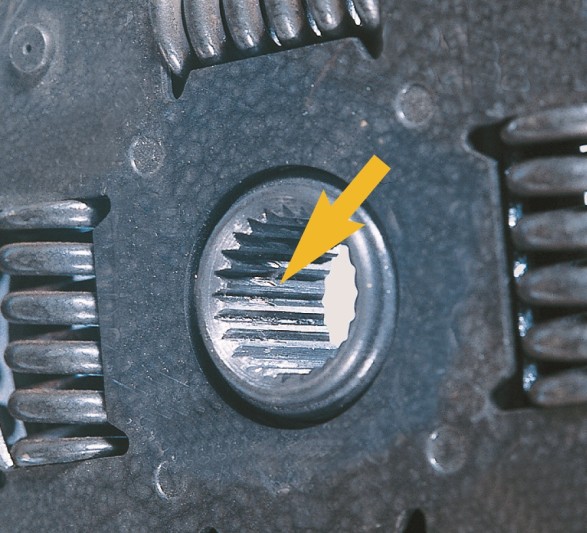
Hub spline damaged
Clutch disk “dished” (arched)
Cause:
- Transmission shaft jammed against clutch disk hub during installation.
- Deformation due to severe overheating (blue discoloration of steel components).
Consequence:
- Prescribed lift on pressure plate is no longer sufficient to smoothly disengage clutch.
Comment:
Also causes drag due to insufficient lift on pressure plate.

Clutch disk “dished” (arched)
Interfacing springs or driving plate fractured
Cause:
- Engine or transmission dropped with the transmission shaft still in the clutch disk hub. Fracture caused by lever effect
- Parallel or angular deviation
Consequence:
- Excessive lateral runout of clutch disk.

Interfacing springs or driving plate fractured
Hub spline worn / burr formation
Cause:
- Clutch housing and crankcase flange not centered, wobble motion due to angular or parallel deviation
- Pilot bearing missing
- Transmission input shaft has excessive play or is not guided
Consequence:
- Hub jammed or tilted on transmission input shaft
Comment:
Can also cause noise.

Hub spline worn / burr formation
Excessive roll speed / burst facings
Cause:
- Driving at high roll speeds in low gear with the clutch pedal depressed, clutch disk exceeds burst speed
- Selecting the wrong (too low) gear when downshifting
Consequence:
- Facing debris gets stuck in the flywheel or in the clutch pressure plate housing.
Comment:
The engine is not involved at all! Facing burst speed is around 1.7 to 2 times higher than the maximum engine rpm. Overheated facings may burst earlier.

Excessive roll speed for facings
Torsional damper destroyed by overloading
Cause:
- Low-revving driving style. Driving in high gear at low speed and full throttle.
- Extreme irregular engine operation
- Worn joints in the driveline
Consequence:
- Fragments are thrown outwards and get stuck in the facings.
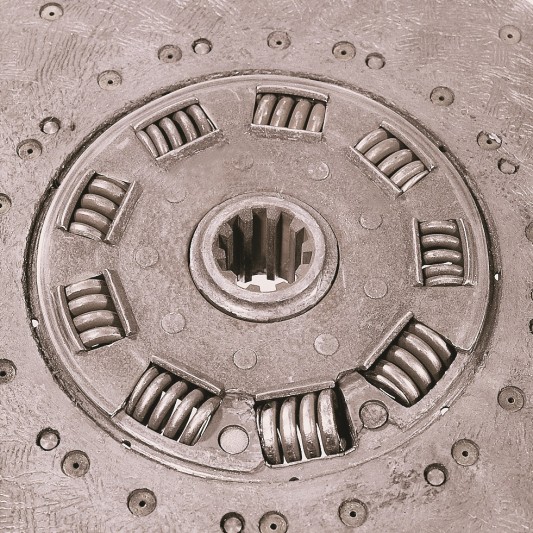
Torsional damper destroyed by overloading
Tangential leaf springs bent or deformed
Cause:
- Extreme thrust load due to incorrect shifting
- Improper towing maneuvers
- Operational errors on the roller test stand
- Play in the driveline
- Deformation during installation
Consequence:
Insufficient pressure plate lift.

Tangential leaf springs deformed
Diaphragm spring contacts torsional damper during release
Cause:
- Permissible release travel exceeded
- Incorrect disk installed
Consequence:
- Diaphragm spring drives clutch disk
Comment:
Also causes noise

Diaphragm spring contacts torsional damper during release
Diaphragm spring tips / release levers ground off
Cause:
- Guide tube for the clutch release bearing bent
- Engine / transmission not correctly centered
Consequence:
- Continuous off-center clutch release bearing contact with the diaphragm spring tips exceeding the self-centering capacity will cause relative motion and therefore wear. This also applies to the release levers.

Diaphragm spring tips ground off
Pressure plate fractured / extreme overheating
Cause:
- Clutch permitted to slip constantly
- Insufficient clamp force
- Problems with the release system, e.g. stiffness or lack of clutch play
- Contamination with oil or grease
- Excessive flywheel thickness
Consequence:
- Insufficient pressure plate lift.

Pressure plate fractured
End plate deformed (MX clutch pressure plates – VW, Audi, Seat, Skoda)
Cause:
- Incorrect clutch pressure plate installed
- End plate / clutch pressure plate incorrectly positioned relative to locating pins on flywheel
Consequence:
- Housing deformed such that pressure plate has insufficient lift.

End plate deformed
Preliminary damper completely destroyed
- Cause:
- Transmission shaft jammed against clutch disk hub during installation.
Consequence:
- Serious damage leading to component failure.
Comment:
Multi-step torsional damping mechanisms have a complex, almost delicate structure. Handle with the utmost care during installation.

Preliminary damper destroyed